


Tables are the clearest way to show pricing, specifications, schedules, and comparisons, and WordPress has no shortage of table plugins. WP Table Manager by JoomUnited stands out because it treats tables like spreadsheets: you edit cells in a grid, import from Excel or Google Sheets, keep them in sync, and even turn the data into charts.
I have used WP Table Manager on client sites that needed to publish spreadsheet data without copying and pasting every week. In this review I cover what it does well, where it falls short, what it costs in 2026, and when you might prefer a different plugin.
About WP Table Manager
WP Table Manager is a premium table builder from JoomUnited, a company that has been making WordPress and Joomla extensions since 2012 (WP Media Folder and WP Meta SEO are theirs too). It is sold directly from their site with a one-time price that includes a year of updates and support, and it works on unlimited sites.
The plugin has been updated steadily since this review was first published, adding database tables, Office 365 sync, user access control, and WooCommerce product tables. The screenshots below reflect the current version.
WP Table Manager Features
Spreadsheet-Style Table Editor
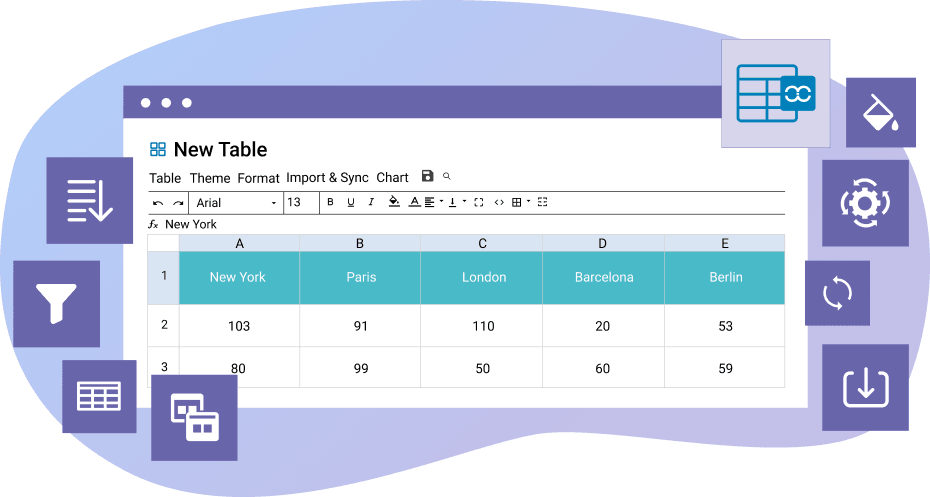
The editor looks and behaves like a spreadsheet. You click a cell to type, drag to select ranges, and apply styling (font, color, background, borders, alignment) to a single cell or a whole selection. Cells can hold HTML, links, and images, and you can merge cells, freeze rows and columns, and use undo and redo. Tables are organized into categories, and you can duplicate a table to reuse its layout.
Themes and Colors
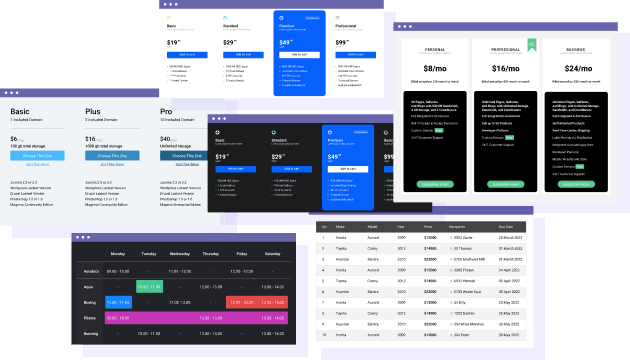
Six built-in themes give you a starting design, and each is editable. You can set alternating row colors, header styles, and borders, and save the result as your own theme. If you need something the options do not cover, there is a custom CSS field per table.
Sorting, Filtering, and Pagination
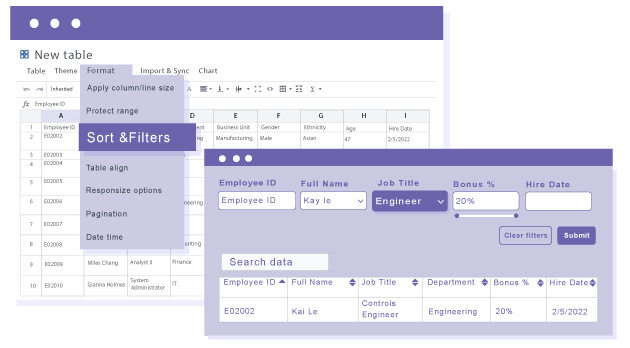
Front-end sorting can be enabled per column, with a default sort order. A search field filters rows as visitors type, and pagination keeps long tables manageable. These are the features that separate a real data table from a static one.
Responsive Tables
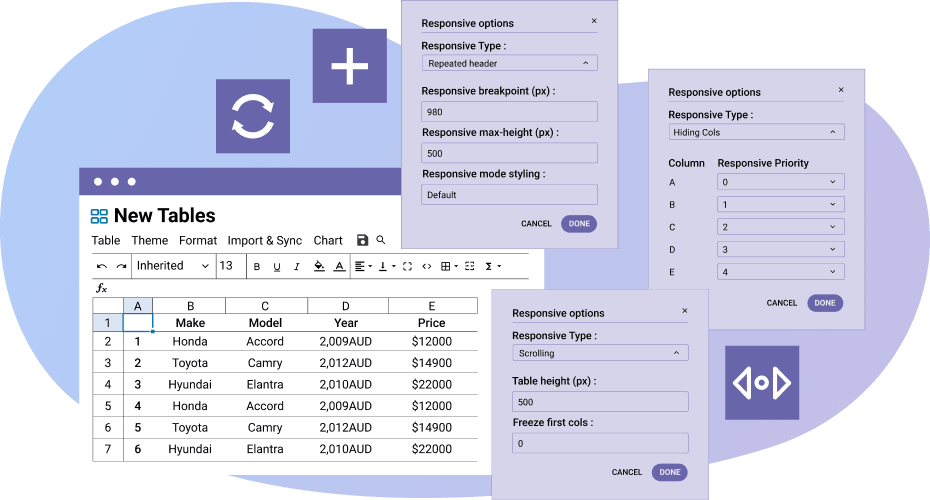
Each table has two mobile modes: horizontal scrolling, or stacking rows so each one reads as a card. You pick the mode per table and can choose which columns stay visible on small screens.
Excel and Office 365 Import and Sync
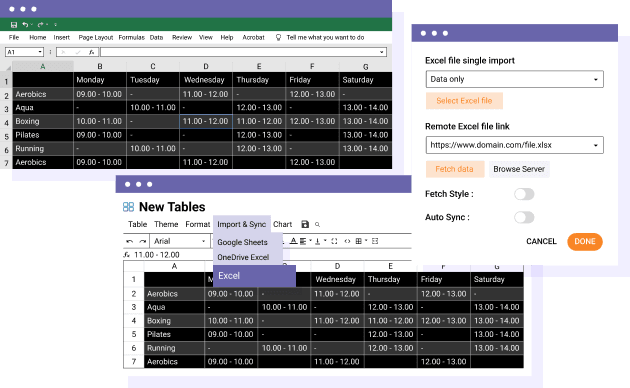
You can import Excel and CSV files, with or without their styling. More usefully, you can link a table to an Excel file on your server or an Office 365 online spreadsheet and set it to sync automatically, so updating the spreadsheet updates the website.
Google Sheets Synchronization
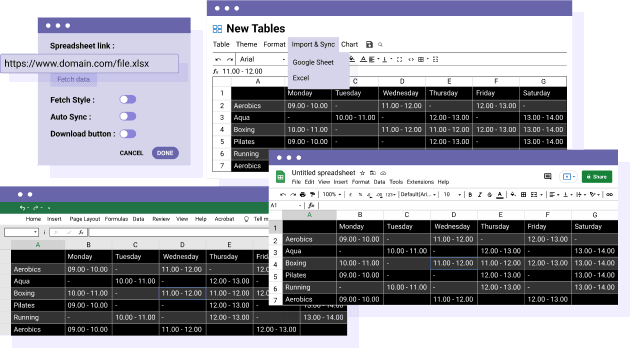
Google Sheets works the same way. Paste the share link, choose whether to import styles, and set a sync interval. It also supports two-way sync, so edits made in WordPress can be pushed back to the sheet. This is the feature most people buy the plugin for.
Charts From Table Data
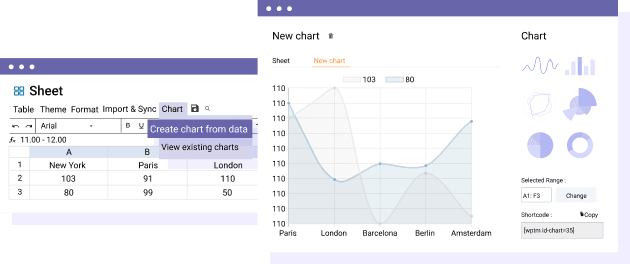
Select a range of cells and WP Table Manager generates a chart from it: line, bar, column, pie, area, or scatter. Charts update when the table data changes, including data that arrives through a Google Sheets sync, and you can insert a chart anywhere with a shortcode or block.
Database and WooCommerce Tables
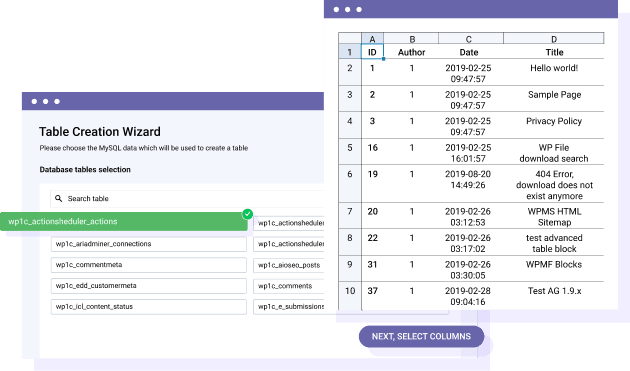
Newer versions let you build a table from your WordPress database: pick a table and columns, add filters, and the output stays current as the data changes. The WooCommerce option does the same for products, so you can publish a filterable product table with prices, stock, and add-to-cart buttons.

User Access and Front-End Editing
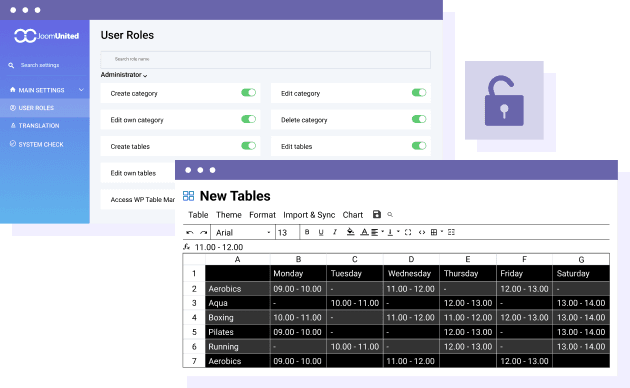
You can restrict who can edit each table by role or by user, lock specific cell ranges, and allow editing from the front end. That makes it practical for sites where several people maintain different tables.
Page Builder Integrations
Tables insert into the block editor with a dedicated block, and there are native integrations for Elementor, Divi, WPBakery, Avada, and others. You can also insert a selection of cells rather than the whole table.
Creating a Table With WP Table Manager
The workflow is short. From WP Table Manager in the admin menu, create a category, then a new table. Choose a starting theme, type or paste your data (or import a file or link a sheet), style it, and set the responsive mode. Save, then add the table to any post or page with the block or shortcode. The whole process takes a few minutes for a simple table.
WP Table Manager Pricing
WP Table Manager is sold as a one-time purchase with no recurring fee:
- WP Table Manager Pro: $49, one-time. Unlimited sites and domains, with one year of updates and support. The plugin keeps working after the year ends; you only lose updates and support unless you renew.
- WordPress Bundle: $199 for all JoomUnited WordPress plugins on unlimited sites, with a year of updates and support.
At $49 for unlimited sites, it is cheaper than most table plugins, which usually charge per site and renew yearly.
Pros and Cons
Pros
- Spreadsheet-style editing that feels familiar
- Google Sheets, Excel, and Office 365 sync, including two-way sync
- Charts generated from table data
- Database and WooCommerce product tables
- One-time price for unlimited sites
- Role-based access and front-end editing
Cons
- No free version to try first
- Small library of pre-made table templates
- The admin interface is dense and takes a little time to learn
- Updates and support stop after one year unless renewed
WP Table Manager Alternatives
If you want a drag-and-drop builder for comparison and pricing tables rather than spreadsheet data, WP Table Builder, developed by our team at WPLeaders, is the better fit. It has a free version, a library of pre-built table templates, and elements such as buttons, star ratings, and images that are built for conversion-focused tables.
For plain data tables with a free option, TablePress is the standard choice and has premium add-ons for Google Sheets import. Ninja Tables and wpDataTables are the other main competitors; wpDataTables is the most powerful for large datasets but costs considerably more.
WP Table Manager is the right pick when the data lives in a spreadsheet and you want it to stay in sync, or when you need charts from the same data.
Frequently Asked Questions
Is there a free version of WP Table Manager?
No. It is a premium plugin at $49 one-time. JoomUnited offers a refund policy, so check the current terms on their site if you want to test it.
Does WP Table Manager sync with Google Sheets automatically?
Yes. You link a sheet and set a sync interval, and the table updates on its own. Two-way sync is also supported.
Can I make charts with it?
Yes. Select a range of cells and generate a line, bar, column, pie, area, or scatter chart that updates with the data.
Does it work with Elementor and Divi?
Yes. It has native integrations for Elementor, Divi, WPBakery, and Avada, plus a block for the WordPress editor.
Is the license a subscription?
No. It is a one-time payment that includes one year of updates and support. The plugin continues to work afterwards.
Conclusion
WP Table Manager is the best table plugin for people who work in spreadsheets. The sync with Google Sheets and Excel, the chart generator, and the database and WooCommerce tables cover needs most table plugins ignore, and the one-time price for unlimited sites is hard to beat. If you mainly need designed comparison or pricing tables, look at WP Table Builder instead.
Leave a Reply